
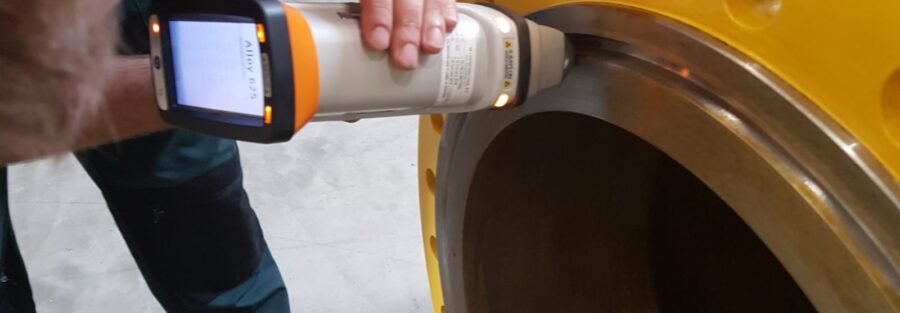
What is PMI?
Positive Material Identification (PMI) is a quick, non-destructive test used to confirm the exact alloy and grade of a metal. It tells you what the material is made of—right on the spot—so you can avoid mix-ups, meet standards, and keep people and plants safe.
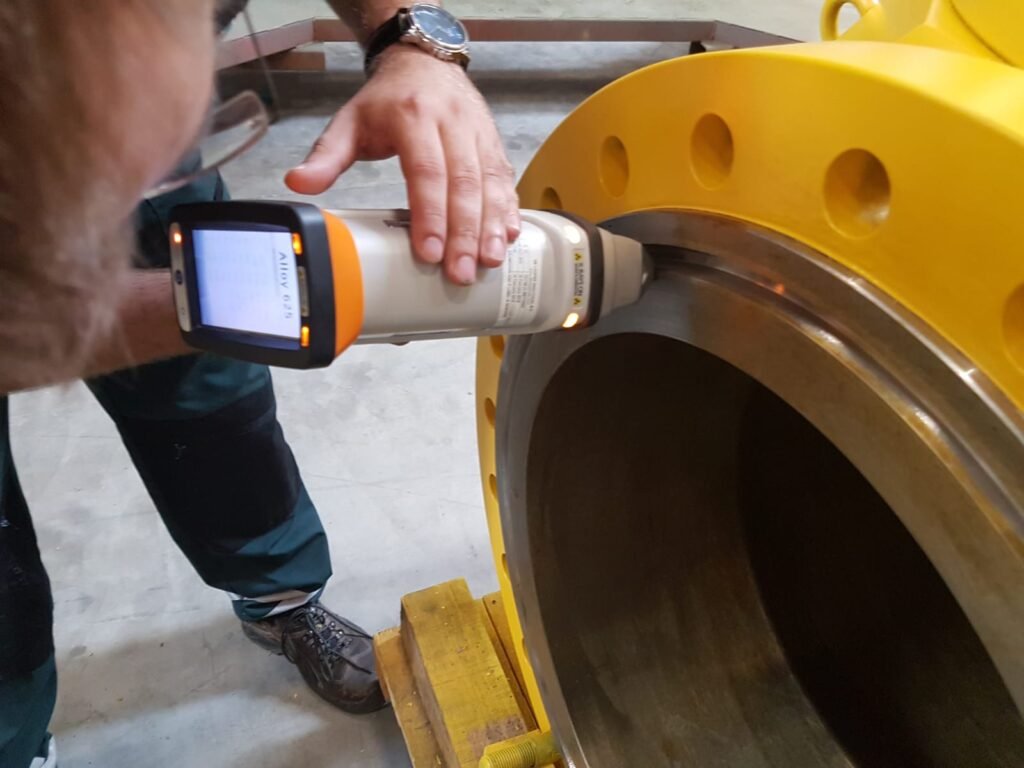
Why PMI Matters
- Prevents mix-ups: Ensures you are using the correct grade (for example, SS304 vs SS316).
- Improves safety: The right material reduces the risk of leaks, failures, and shutdowns.
- Saves money: Avoids costly rework, warranty issues, and downtime.
- Meets standards: Helps comply with customer specs, codes, and audits (e.g., API 578 guidance for PMI programmes).
- Builds traceability: Confirms that what was ordered, delivered, and installed are the same.
Where PMI Is Used
- Oil & Gas and Petrochemicals: Piping, valves, flanges, and welds.
- Power Plants: Boiler tubes, headers, and turbine components.
- Pharmaceutical & Food: Sanitary process lines and equipment.
- Fabrication & EPC: Incoming material checks and shop-floor verification.
- Aerospace & Automotive: Critical alloy parts and heat-treated components.
- Metal Recycling & Warehousing: Fast sorting and inventory control.
When to Do PMI
- Incoming inspection: Check material as it arrives from suppliers.
- During fabrication: Before cutting, welding, or assembly.
- Before commissioning: Final checks before the system starts up.
- Turnarounds & shutdowns: Verify during maintenance to avoid surprises.
- After repairs or replacements: Confirm the correct spares and weld consumables.
How PMI Is Done (Main Technologies)
1) XRF (X-Ray Fluorescence)
- What it does: Uses low-energy X-rays to excite atoms and read their “fingerprint.”
- Best for: Most alloys—stainless steels, nickel alloys, copper alloys, and more.
- Strengths: Fast (often seconds), non-destructive, handheld, minimal surface prep.
- Limitations: Cannot reliably measure light elements like C, B, Li, Be, Mg, Al, and Si in some cases. Not for coating thickness on very thin layers unless specialised.
2) OES (Optical Emission Spectroscopy), including Spark OES
- What it does: Creates a small spark on the surface; the emitted light reveals exact chemistry.
- Best for: When you must know carbon (e.g., distinguish SS304 vs SS304L/SS316/SS316L, low-alloy steels), sulfur, phosphorus, and other light elements.
- Strengths: High accuracy for carbon and light elements; good for mill-grade confirmation.
- Limitations: Slightly more surface prep; leaves a tiny spark mark (lightly destructive).
What PMI Reports Usually Include
- Test method and instrument ID
- Date, location, and operator
- Material grade and heat number (if available)
- Elemental composition with pass/fail or grade match
- Marking/tagging details and photos (if required)
- Reference standards and calibration info
Good Practices for PMI Programmes
- Define the scope: Which lines, systems, or components need PMI? Focus on high-risk services (corrosive, high temp/pressure, toxic).
- Select the method: Use XRF for general alloy ID; switch to OES when carbon/light elements matter.
- Prepare surfaces: Clean rust, paint, and scale for accurate readings.
- Set acceptance criteria: Align with purchase specs, drawings, and standards.
- Traceability: Link results to tags, heat numbers, and isometric drawings.
- Sampling plan: 100% for critical points; risk-based sampling for the rest.
- Document & label: Keep clear records; tag verified items to avoid re-testing.
- Calibrate regularly: Use certified reference materials (CRMs); follow the instrument’s QA checklist.
- Train personnel: Ensure operators understand alloy systems, limitations, and safety.
- Review & audit: Periodically check results and adjust the plan as needed.
Common PMI Use Cases (With Tips)
- Distinguishing similar stainless steels: Use OES when carbon content makes the grade difference (e.g., 316 vs 316L).
- Verifying weld filler metals: Confirm filler electrodes/rods match WPS/PQR requirements.
- Mixed-up bins or labels missing: Use XRF to quickly sort and relabel.
- Legacy/unknown systems: Build a materials map before modifications or debottlenecking.
- High-temp hydrogen service: Verify Cr-Mo-V levels and other alloying elements per spec.
Limitations to Remember
- Surface condition affects results: Dirt, coating, and scale can bias readings.
- Geometry matters: Very small or curved parts may need special handling.
- Carbon requires OES: If carbon content is critical, don’t rely on XRF alone.
- NDT vs destructive: PMI is primarily non-destructive; cutting for lab analysis is a separate, more detailed step when needed.
Safety Notes
- For XRF, follow radiation safety procedures and use trained operators.
- For OES, protect from sparks; ensure proper PPE and grounding.
- Keep work areas clear; mark tested/untested components to avoid confusion.
Frequently Asked Questions (FAQ)
Q1: Is PMI the same as a lab test?
No. PMI is usually an on-site screening/confirmation method. For full certification or dispute resolution, lab spectroscopy may still be required.
Q2: How accurate is PMI?
Very accurate for most alloying elements. For carbon and light elements, use Spark OES. Always compare to your acceptance limits.
Q3: Will PMI damage my equipment?
XRF is non-destructive. Spark OES leaves a tiny mark about the size of a pinhead.
Q4: Do I need PMI if I have Mill Test Certificates (MTCs)?
Yes, for critical service. PMI verifies that the installed material actually matches the documents.
Q5: Which standards are relevant?
Many plants follow internal specs and industry guidance such as API 578 for building PMI programmes. Always align with your contract and code requirements.
Simple PMI Workflow
- Review drawings, P&ID, and criticality list.
- Choose method: XRF first; OES where carbon/light elements matter.
- Clean the test spot.
- Measure and record readings.
- Compare to spec; mark PASS/FAIL.
- Tag and photograph (if needed).
- Issue report and update traceability records.
Conclusion
PMI helps you confirm the right material, in the right place, at the right time—reducing risk, saving costs, and supporting compliance. Whether you need quick sorting with XRF or precise chemistry with Spark OES, a well-planned PMI programme keeps your operations safe and reliable. For guidance, on-site testing, and clear reporting, Corresafe Consultant is ready to help.