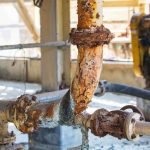
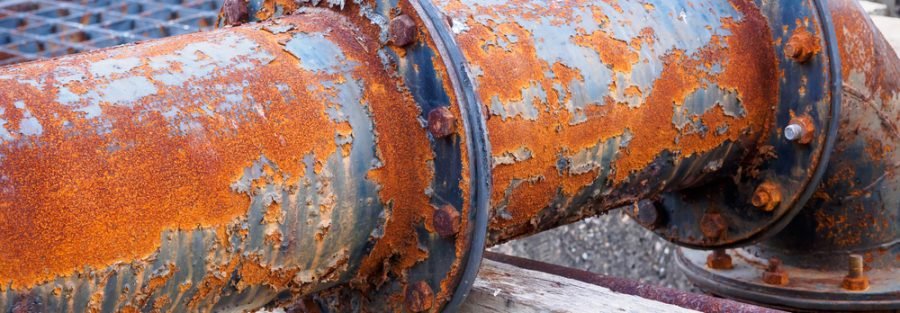
Corrosion Under Pipe Supports, as the name suggests, is corrosion that occurs at the interface between a metal component and the object supporting it. Support locations such as brackets and clamps tend to act as entrapment areas for water and other liquids that can result in corrosion. This type of corrosion, highly localized and sometimes resulting in pits and other forms of damage, is extremely difficult to inspect. Water trapped under supports remains stagnant, forming ideal conditions for localized crevice corrosion.
As the paint/coating system fails, corrosion attacks the metal component leading to other types of corrosion such as pitting and mesa attack, a common type of corrosion where low alloy steels and carbon are exposed to conditions of wet carbon dioxide at elevated temperatures.
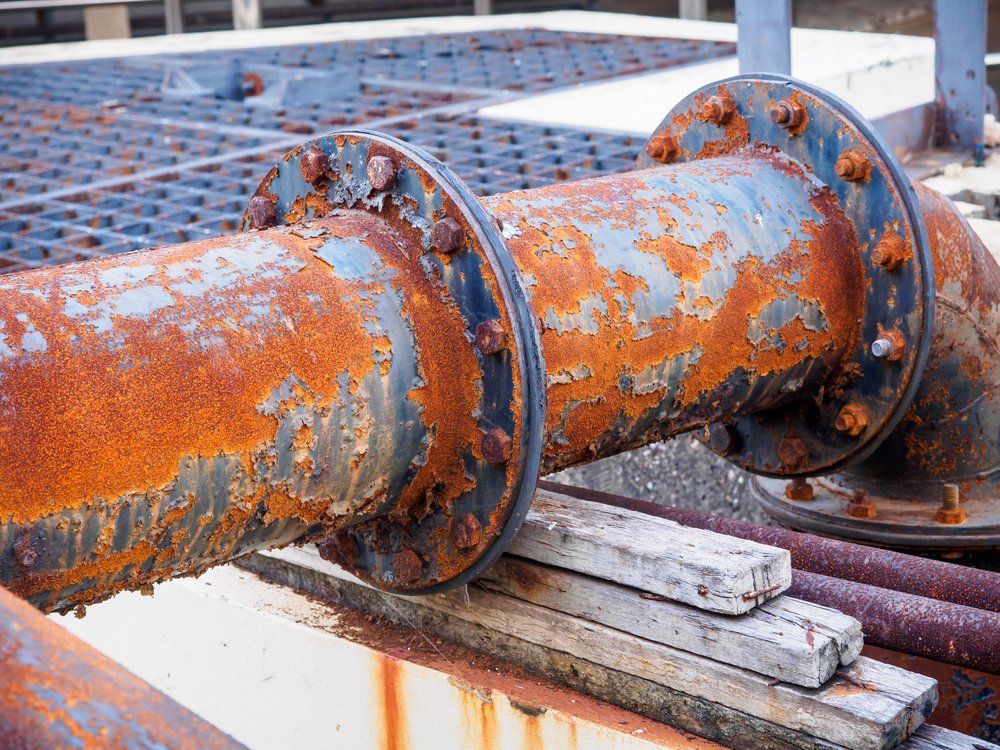
The assumption of a country in the world without a large and complex network of pipelines is similar to a human body with no arteries. Pipelines that transport and distribute oil, gas, chemicals, water, steam, petroleum products and other substances are of critical significance for the economy. And the health of these critical assets is severely endangered by electrochemical deterioration, or corrosion.
Pipeline corrosion is the deterioration of pipe material and the related system due to its interaction with the working environment. It affects pipeline and accessories made of both metals and non-metals. Pipeline corrosion—and the related catastrophic failures that it can cause—cost billions of dollars to the economy.
Here we’ll take a look at the key types of corrosion that affect pipelines, and some of the methods that are used to protect this infrastructure.
The Corrosion Process
Corrosion of most pipelines occurs due to an electrochemical reaction in the presence of an electrolyte. The electrochemical nature of the process also facilitates the detection and mitigation of this deterioration, which is accomplished by monitoring the voltages and the currents associated with the corrosion rate.
The rate of corrosion of a piping system is generally related to both external and internal factors. External factors include a working environment of pipes, soil chemistry and moisture for buried pipes or water chemistry in the case of submerged pipes.
Internal factors that contribute to corrosion may include:
- The oxygen content or reactivity of liquids and gases carried
- The use of dissimilar metals within the piping system
- The temperature, flow rate and pressure of the fluids and gases
Types of pipes supports
1. Standard beam support:
The pipe is rested on, or secured to, a support member usually of a standard structural shape (I-beam, wide flange beam, angle, channel, etc.). The pipe may be secured to this member with a stabilizing U-bolt.
2. Saddle clamp:
Pipe is clamped between two rolled plates. One of these plates has a structural element welded to it which attaches the pipe to the support structure.
3. Welded support
This type of support involves welding a part to the pipe which is usually free to move at the interface to the support. There are a number of variations on this theme, and is a common approach for insulated piping systems.
4. Others
There are a number of other methods used, such as flange bolt supports, various type of pipe hangers and other specialty-type supports. However, the first two categories account statistically for better than 95% of support points on a typical offshore structure.
Problems
Important to note that, it is the beam supports and the saddle clamps that have historically caused the majority of the problems. They have the following undesirable features in common:
1. Crevice forming – This is the root of the problem: the formation of a crevice at the pipe surface.
2. Water trapping – These support types all allow water to be trapped and held in contact with the pipe surface.
3. Poor inspectability and maintainability – These support types make it virtually impossible to paint or otherwise maintain some areas of the pipe at the support. Visual inspection is often difficult, and until fairly recently, it was also very difficult to inspect these areas with NDT methods.
4. Galvanic couple forming – Some of these support types may develop bi-metallic contact. Even though both the pipe and support are steel, the metallurgical differences can still provide a small potential difference to create a corrosion cell.
The corrosion mechanism
It is a common misconception that metal-to-metal contact coupled with water entrapment is the major cause of corrosion at these points. This is not the case; the sequence of events is as follows:
1. Water is trapped – The very nature of the supports allows water to be held in contact with the painted pipe surface as well as the paint on the support element.
2. The paint system fails – Even if the paint on the pipe and support beam are perfect, the paint system is designed for atmospheric exposure and not immersion service. The longer the paint surface is continuously exposed to water, the more it softens. As the pipe softens, it is inevitable that the steel substrate will be directly exposed to the water.
3. Corrosion is initiated – The small area of steel now exposed to oxygenated water (often with high chlorides) starts to corrode.
4. Corrosion undercuts paint film – The initial corrosion soon undercuts and spreads. Soon the whole support area is bare steel.
5. Crevice corrosion starts – From this point on, the crevice corrosion driven by differential aeration takes over from the general corrosion mechanism that initiated the corrosion. As corrosion products build, they further restrict oxygen diffusion and the oxygen concentration gradient gets steeper. Pitting now becomes the main problem with corrosion rates accelerating by an order of magnitude.
6. Pipe fails – If the inspection program is not set up to detect this mostly concealed wall loss, the pipe will fail.
Conclusion
When designing pipe supports, avoid the use of saddle clamps wherever possible. Never use a rubber pad between a pipe and a pipe support if the area is exposed to a corrosive environment. When using U-bolts to stabilize piping, always use polymer-sheathed bolts. The half-round rod solution has proven to be very effective in controlling pipe-support corrosion.