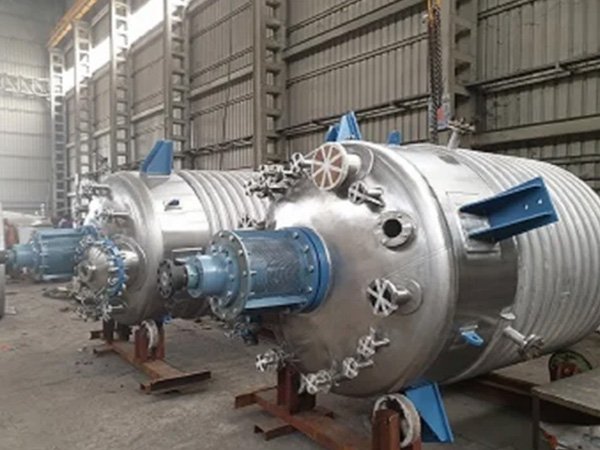
CorroSafe successfully completed a Root Cause Analysis (RCA) for an Agro Chemical Industry client facing frequent and premature failures of its jacked carbon steel reactor-severe thinning and pinhole punctures on shell, agitator blade thinning, erosion with flow patterns. This is a systemic issue affecting all 24 reactors in the plant.
The SA-516 Grade 70 reactors were failing rapidly (within 2–3 years of installation) due to their exposure to a highly alkaline (pH 12–14) and high-temperature (240–330°C) castor oil cracking process. The current maintenance approach is reactive, focusing only on temporary fixes like shell patch plates and agitator repairs, which fails to address the underlying causes.
Our investigation identified a critical material selection flaw compounded by multiple degradation mechanisms. The recommended material upgrade and operational fixes ensure long-term equipment integrity and a significant reduction in Life Cycle Costs (LCC).
Key Findings & Recommended Actions
Primary Root Cause (Systemic): Inappropriate selection of SA-516 Grade 70 Carbon Steel for hot caustic service, operating at temperatures that exceed recommended limits.
Contributing Degradation Mechanisms:
Caustic Embrittlement/Corrosion: Accelerated by the absence of Post-Weld Heat Treatment (PWHT) on weld joints.
Localized Corrosion: Failures resulted from Dew Point and Splash Zone Corrosion in the top shell.
Operational Flaw: Reactive use of steam dechoking to clear the choked vent line introduced water vapor, creating a highly aggressive, cyclical corrosive environment.
Recommended Solution & ROI:
Long-Term Upgrade: Upgrade the reactor shell material to Hastelloy C-276 Clad over Carbon Steel. This nickel-based alloy offers outstanding resistance to hot concentrated caustic and is highly resistant to stress corrosion cracking and chlorides.
Economic Justification: The LCC analysis confirmed that the Hastelloy C-276 Clad option, with an expected 12-year life, yields the lowest LCC over a 12-year period.
Immediate Operational Fixes:
Implement trace heating/insulation on the vent line to prevent choking and residue condensation and liquid entrainment.
Mandate PWHT for all new fabrication and review agitator design to minimize shear stress.
Increase inspection frequency using NDT methods in degraded zones to track thinning rates and predict future failures.
Upgrade the agitator material and review the design (RPM analysis) to minimize shear stress and splashing, mitigating erosion-corrosion.
The Takeaway
This case highlights that for aggressive high-temperature, high-pH services, even common carbon steel reactors are vulnerable to rapid, synergistic failure when materials and process deviations align. CorroSafe’s LCC-based analysis provided the client with the essential proof that investing in a premium nickel alloy, specifically Hastelloy C-276 Cladding, delivers the highest Return on Investment (ROI) and ensures safer, more sustainable operations.