Remaining Life Assessment (RLA) of Underground Methanol Storage Tank
Case Studies
Remaining Life Assessment (RLA) of Underground Methanol Storage Tank
CorroSafe successfully executed a comprehensive Remaining Life Assessment (RLA) for a 20 kL underground methanol storage tank. Having been in continuous operation since 2000, the asset required a rigorous engineering evaluation to determine its structural integrity and estimate its remaining safe service life after 26 years of exposure.
The assessment focused on the tank’s construction material (IS 2062 Grade B), identifying active degradation mechanisms and providing a data-driven roadmap for continued operation or replacement.
Key Findings & Engineering Observations
Primary Root Cause: Long-term service handling methanol without an internal protective lining, resulting in progressive atmospheric and chemical oxidation of the internal surfaces.
Technical Observations & Degradation Mechanisms:
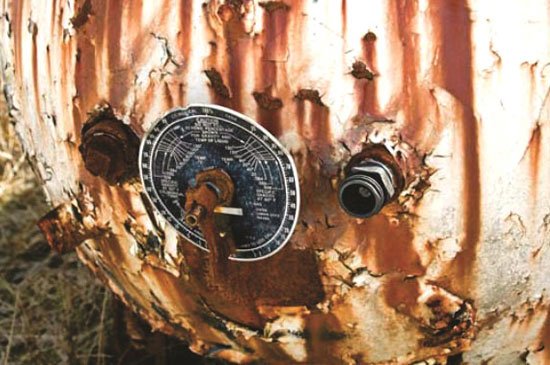
General Internal Corrosion: Extensive oxidation, rust scaling, and flaking were observed across the internal shell and end plates.
Weldment Discontinuities: Dye Penetrant Testing (DPT) identified several surface-breaking defects, including porosity and pinhole indications, particularly in the dip pipe and nozzle-to-shell joints.
Material Thinning: Ultrasonic Thickness Measurement (UTM) recorded a reduction from the nominal 10 mm thickness, calculating a long-term corrosion rate of approximately 0.10–0.11 mm/year.
In-Situ Metallography: Confirmed a normal ferrite-pearlite microstructure with no signs of advanced metallurgical degradation like micro-cracking.
Hardness Testing: Results were within acceptable industrial ranges, indicating no abnormal material hardening.
Subsurface Uncertainty: Due to the tank’s installation in a sand-filled underground vault, the external surface remained inaccessible. This introduces a significant risk of unquantified soil-side corrosion.
Inspection & Testing Methodology: The study was conducted in strict accordance with the following Reference Standards:
ASME BPVC Section V, Article 4: For Ultrasonic Examination and straight-beam thickness measurement.
IS 2062: For verification of structural steel material properties.
Good Engineering Practice (GEP): Applied for atmospheric storage tank integrity where specific design codes were unavailable.
Recommended Solution & Integrity Management
Long-Term Asset Strategy:
Internal Surface Protection: It is recommended to perform abrasive blasting, followed by the application of a high-build, methanol-compatible chemical-resistant lining to arrest further internal metal loss.
Structural Repairs: All porosity and pinhole defects identified during NDT must be ground out and repaired by qualified welders to restore pressure-boundary integrity.
External Risk Mitigation: CorroSafe recommends partial excavation to validate the external condition of the shell.
Immediate Operational Controls:
Enhanced Inspection Frequency: The next thickness monitoring cycle should be scheduled within 3–5 years to track thinning rates in high-corrosion zones.
Operational Validation: Continuous monitoring of fluid chemistry to ensure no aggressive contaminants are accelerating the degradation of the base metal.
The Takeaway
The assessment by CorroSafe concluded that while the tank retains a calculated remaining life of 10–12 years, its reliability is conditional upon immediate remedial action.
By integrating NDT data with metallurgical analysis, CorroSafe provided the client with the essential technical evidence required to transition from reactive maintenance to a proactive integrity management strategy. This ensures that the asset can be operated safely in the medium term while allowing for a planned, capital-expenditure-led replacement strategy in the future.